

Blog
Fluted Wall Panels Dubai: The Complete WPC & LED Guide (2026)


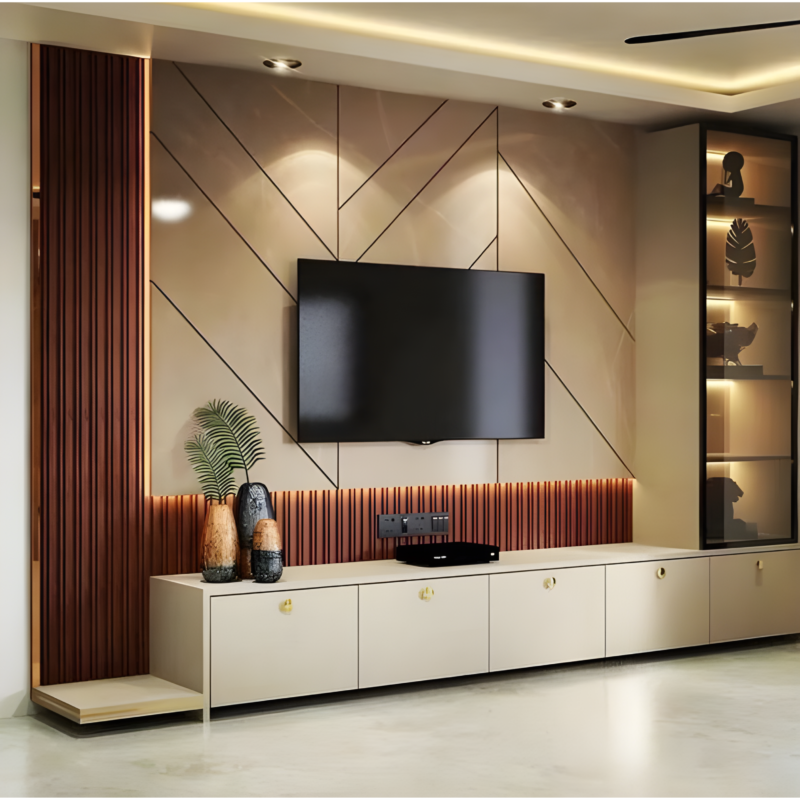
Fluted wall panels in Dubai are the defining interior finish of 2026: vertical wood-slat panels, usually in walnut or black oak, running floor to ceiling behind a TV or bed, with a thin line of warm LED light glowing between the ribs.
Unlike a lot of trends, there are real functional reasons behind their popularity in Dubai and Abu Dhabi homes. Here is everything worth knowing before you commit to fluted wall panels.
In this guide
- What fluted wall panels are
- WPC vs MDF vs solid wood
- Panel width and spacing
- Wood tones
- LED integration
- Where fluted wall panels work best
- Cleaning and maintenance
- Fluted wall panels cost in Dubai
- FAQ
What fluted wall panels actually are
Fluted (also called reeded, ribbed, or slat) panelling is a wall surface made of repeated vertical ribs with recessed channels between them. The effect is texture and shadow. The wall changes appearance through the day as light moves across it, which a flat painted wall never does.
The terms get used loosely, but there is a rough distinction: fluted typically means rounded or half-round ribs, reeded means narrower and more closely spaced, and slat usually refers to squared-off battens with wider gaps between them. In practice, most UAE suppliers use the terms interchangeably.
WPC vs MDF vs solid wood for fluted wall panels in Dubai
This is the most important decision, and the one that most affects how the wall looks in five years.
WPC (wood-plastic composite)
WPC is the safest default for UAE homes. Wood-plastic composite combines wood fibre with polymer, producing a panel that is dimensionally stable in humidity, resistant to warping and moisture damage, and available in convincing wood-grain finishes. Because the UAE cycles between high outdoor humidity and dry air-conditioned interiors, materials that move with moisture content are a genuine long-term risk. WPC largely removes that concern.
MDF with veneer or foil wrap
Affordable, and in a consistently air-conditioned room it performs perfectly well. The risk is rooms that are not conditioned year-round, or any proximity to moisture. MDF swells if it gets wet, and once it does, it does not recover.
Solid timber
The most beautiful option, with genuine grain variation no composite fully replicates. Also the most expensive, the heaviest to install, and the most sensitive to humidity swings. Worth it in a well-conditioned formal space where the material quality will be noticed.
Panel width and spacing: getting the proportions right
This is where fluted wall panels succeed or fail, and it is rarely discussed.
Narrow flutes (30 to 50mm) read as fine texture. Elegant in smaller rooms and on shorter walls. Across a very large wall, they can become visually busy, because the eye reads noise rather than pattern.
Medium flutes (60 to 80mm) are the most versatile. They have enough definition to create shadow, and are wide enough not to feel fussy across a full wall.
Wide slats (100mm+) with visible gaps suit large villa walls and double-height spaces, where narrower profiles would lose their impact at a distance.
The general rule: the larger the wall and the further away it is typically viewed from, the wider the flute should be.
Wood tones for fluted panels and where each works
Walnut is the most-requested tone in the UAE. Warm, mid-to-dark, and it works with both cream and beige schemes and cooler greys.
Black oak / charcoal is the most dramatic. Excellent behind a TV, since a switched-off screen disappears into it. Needs good lighting or the wall can feel heavy.
Natural / light oak is best for smaller apartments and rooms with limited natural light, where darker panelling would close the space in.
Grey / smoked oak is a neutral middle ground that pairs well with marble-effect surfaces and cooler-toned interiors.
White / painted gives you the texture and shadow of fluting without introducing a wood tone into the scheme. Underrated, especially in bedrooms.
LED lighting for fluted wall panels: the detail that makes it
Fluted panelling looks good on its own. With integrated LED, it looks custom. Three approaches:
Channel lighting: LED strip set inside the recess between flutes, so light washes vertically along the panel. The most common approach and the most striking at night.
Perimeter backlighting: LED behind the panel’s outer edge, so the whole panelled section appears to float off the wall. Subtler and less directly visible.
Grazing light: a strip at the top or bottom of the wall, throwing light across the panel surface at a shallow angle to exaggerate the shadow between the ribs. Most effective on deeper flute profiles.
Practical guidance: choose warm white (2700 to 3000K) for living rooms, bedrooms and majlis spaces. Cool white makes wood tones look grey and lifeless. Always specify a dimmable driver, because full-brightness LED behind panelling is almost always too much in the evening.
Where fluted wall panels work best in Dubai homes
Behind a TV (media wall). The single most common application, and for good reason. The vertical texture gives the screen a designed context instead of a blank wall, and the flutes conceal the panel joins around a recess. See our media wall collection for examples.
Behind a bed (bedroom feature wall). A softer alternative to an upholstered headboard wall, and it doubles as sound absorption.
Hallways and entrance corridors. Long, narrow spaces benefit enormously, because vertical ribbing breaks up what would otherwise be an uninterrupted stretch of wall.
Majlis and formal reception. Especially in darker tones with brass trim detail.
Kitchen islands and bar fronts. Applied to vertical furniture faces rather than walls, a growing application in villa kitchens.
Where it works less well: bathrooms and wet areas (the channels trap moisture and are awkward to clean, so use PVC panelling instead), and very small rooms where floor-to-ceiling texture on multiple walls becomes overwhelming.
Cleaning and maintenance
The honest drawback: the channels between flutes collect dust more readily than a flat wall. A vacuum brush attachment run vertically down the panel every few weeks handles it easily, but it is a consideration in a dusty climate. Wider flute profiles with shallower channels are noticeably easier to maintain than narrow, deep-profile panels, which is worth factoring in if low maintenance matters to you.
Fluted wall panels cost in Dubai: what drives the price
Fluted wall panels in Dubai are priced per square metre, with the main variables being material (WPC sits mid-range; solid timber is the premium option), flute profile depth, whether LED channels are integrated, and whether the panelling is a standalone feature wall or part of a full media wall build with storage and a TV recess.
At AlUmaima Interiors, made-to-measure media walls are currently listed from AED 900 per sqm at offer prices. Full breakdown in our media wall cost guide.
Will fluted wall panels date?
The honest answer: the material will not, but a badly executed version will look dated fast.
Vertical reeded detailing has appeared in interiors for close to a century. It is not a new invention, and it keeps returning because it works. What dates is over-application: fluting on every wall of a room, combined with several other trend finishes at once, in a tone chosen because it was popular rather than because it fits the scheme.
One well-proportioned fluted wall in a tone that suits the rest of the room will still look considered in ten years. Four fluted walls in whatever shade is trending will not.
Fluted wall panels Dubai: frequently asked questions
Are WPC fluted wall panels better than MDF for Dubai’s climate?
Generally yes. WPC is dimensionally stable in humidity and will not swell or warp if exposed to moisture, whereas MDF is vulnerable in unconditioned rooms or near water.
Can fluted wall panels be installed in a rented apartment?
Depending on the fixing method, yes. Some systems can be installed with minimal wall damage. Check with your landlord or building management first, since many Dubai and Abu Dhabi towers require approval for fit-out work.
How difficult are fluted panels to clean?
The channels collect dust. A vacuum brush attachment run vertically handles it in a couple of minutes. Wider, shallower profiles are easier to maintain than narrow deep ones.
Do fluted panels help with sound?
The texture does provide some diffusion, which can slightly reduce echo in hard-surfaced rooms. They are not acoustic panels, though, and some products include an acoustic felt backing if sound is a real priority.
What is the difference between fluted, reeded and slat panelling?
Fluted usually means rounded ribs, reeded means narrower closely-spaced ribs, and slat means squared battens with visible gaps. In the UAE market the terms are largely used interchangeably.
What flute width should I choose?
Narrow (30 to 50mm) for smaller walls and finer texture; medium (60 to 80mm) for most rooms; wide (100mm+) for large villa walls and double-height spaces.
Looking for layout inspiration? See our 25 media wall design ideas for Dubai and Abu Dhabi homes, or read the difference between a TV wall and a media wall.
Thinking about fluted wall panels in Dubai or Abu Dhabi? AlUmaima Interiors manufactures and installs WPC fluted panelling and LED media walls across both emirates, with free installation anywhere in the UAE. Get a free quote or browse our media wall designs.